Investment casting is one of the oldest metal-forming methods still in daily use, and one of the most precise. If you are sourcing parts with thin walls, internal passages, or tight tolerances, Investment Casting Services are often the most practical route from drawing to finished component. The process produces near-net-shape parts in almost any alloy, which means less machining, less scrap, and fewer compromises on design. This guide explains how it works, where it fits, what it costs, and what to check before you award a purchase order.
At Overland Engineering and Logistics LLC, we work with engineers and procurement teams every day on exactly these questions, so the advice below comes from practical sourcing experience rather than theory.
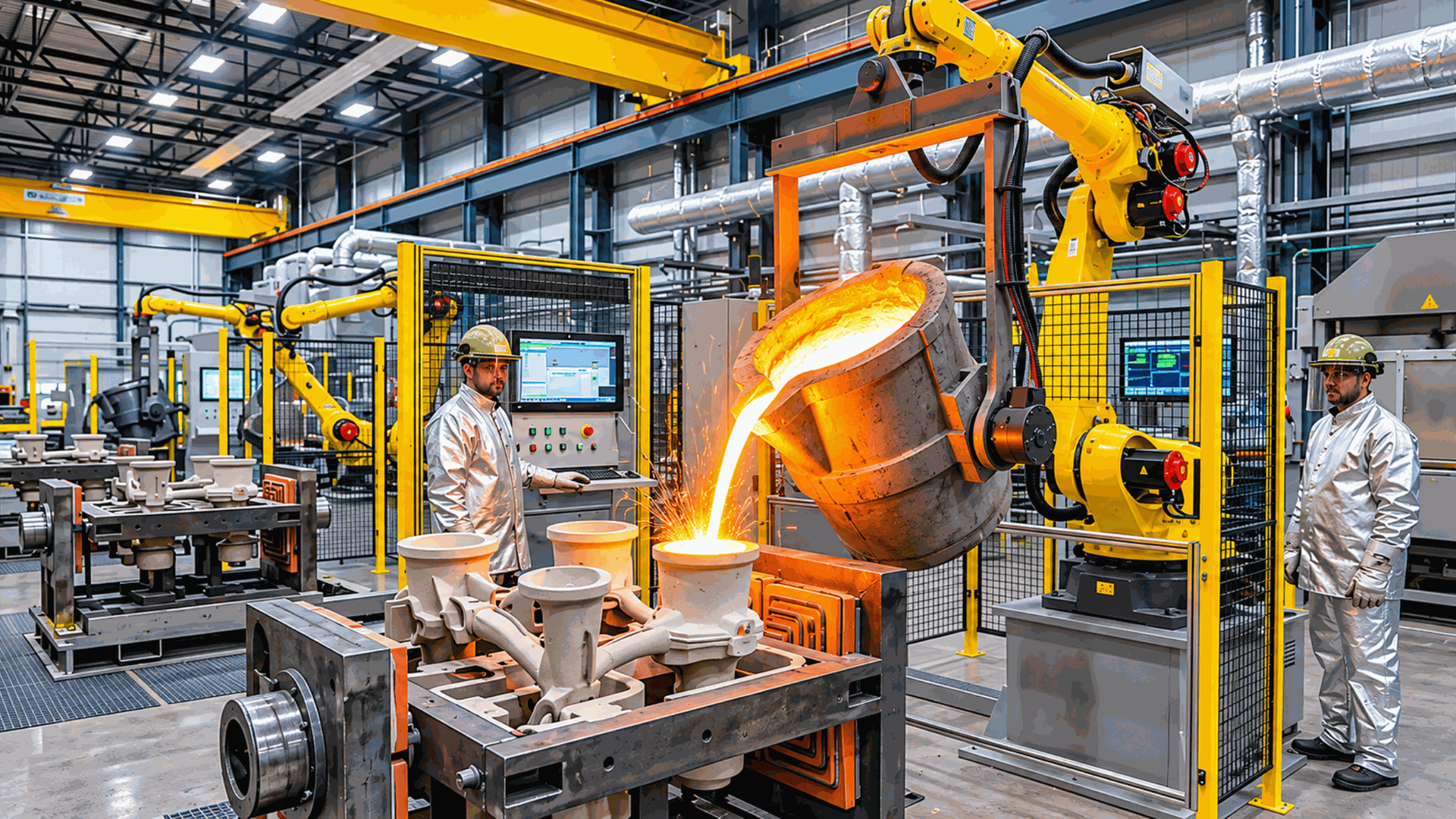
How Investment Casting Works
The process is also called lost-wax casting, because the pattern is melted out of the mold. The main steps are:
- Wax pattern. Molten wax is injected into a metal die to form a replica of the part. Multiple patterns are attached to a central wax runner, creating a “tree.”
- Ceramic shell. The tree is dipped into ceramic slurry and coated with fine sand, then dried. This is repeated several times until the shell is thick enough to handle molten metal.
- Dewaxing. The shell is heated in a steam autoclave or furnace, and the wax runs out, leaving a hollow ceramic mold.
- Pouring. The mold is fired to burn off residue, then filled with molten metal while still hot, which helps the metal reach thin sections.
- Finishing. After cooling, the shell is knocked off, parts are cut from the tree, ground, heat treated if required, and inspected.
Because the mold is a single seamless piece with no parting line, the surface finish and dimensional accuracy are far better than in sand casting.
Where It Performs Best
Investment casting is not the cheapest option for every part, but it is hard to beat in specific situations:
- Complex geometry. Undercuts, internal cavities, and fine details that would need assembly or heavy machining can often be cast as one piece.
- Tight tolerances. Typical linear tolerances run around ±0.1 mm per 25 mm, and surface roughness is commonly 1.6 to 3.2 µm Ra.
- Hard-to-machine alloys. Stainless steels, nickel superalloys, cobalt alloys, and titanium are expensive and slow to cut from bar stock. Casting them near net shape saves real money.
- Small to medium runs. Tooling costs less than forging or die casting dies, so batches from a few hundred to tens of thousands of pieces make economic sense.
You will find cast components in pumps, valves, turbine blades, medical implants, firearm parts, automotive turbochargers, and food-processing equipment.
Materials You Can Cast
Most ferrous and non-ferrous alloys work. Common choices include 304 and 316 stainless steel, 17-4 PH, duplex grades, carbon and alloy steels, aluminum A356, bronze, and Inconel. Material selection should follow the operating environment first: corrosion, temperature, pressure, and wear. Cost comes second. A good foundry will question your specification if it sees a mismatch, and that is a sign of experience, not obstruction.
Design Tips That Save Money
Small design decisions made early have an outsized effect on yield and price:
- Keep wall thickness as uniform as possible. Sudden changes cause shrinkage porosity.
- Add generous radii. Sharp internal corners create stress and make shell building harder.
- Avoid very deep, narrow holes. Drill them afterward instead.
- Specify tight tolerances only on critical features. Every extra tolerance callout adds inspection time and rejects.
- Talk to the foundry before finalizing the drawing. Gating and feeding strategy depend on part shape, and a ten-minute conversation can prevent a tooling revision.
Quality Control: What Buyers Should Ask For
A casting is only as good as the process behind it. Ask your supplier about:
- Chemical analysis by spectrometer on every heat
- Dimensional inspection with CMM or 3D scanning
- Non-destructive testing, such as penetrant, magnetic particle, radiographic, or ultrasonic, matched to part criticality
- Mechanical testing and heat treatment records
- Traceability from raw material to shipment
- Certifications such as ISO 9001, and IATF 16949 or AS9100 if your industry requires them
Request a first article inspection report on new parts and agree on acceptance criteria in writing before production begins.
Cost and Lead Time
Cost depends on part weight, alloy, complexity, tolerance, and volume. Tooling for a wax die typically takes three to six weeks to build, and first samples follow shortly after. Production lead times usually fall between four and eight weeks. Hidden costs to watch for include secondary machining, heat treatment, special testing, and freight. Compare quotes on a total delivered basis, not just piece price.
Why Sourcing Strategy Matters
Many buyers now look beyond their home region for industrial manufacturing solutions that balance cost, quality, and supply security. Southeast Asia has become a serious option, and working with a reliable Factory and Thailand Partner can give you shorter shipping routes to ASEAN markets, stable labor and energy costs, and a diversified supply chain that does not depend on a single country. The best arrangements pair a capable foundry with a local team that handles communication, inspection, and logistics, so engineers get clear answers and buyers get predictable deliveries.
Whatever location you choose, visit or audit the foundry if you can. Look at the wax room, the shell room, and the inspection lab. A clean, organized floor tells you more than a brochure.
Frequently Asked Questions
1.What is the difference between investment casting and sand casting?
Investment casting uses a ceramic shell made from a wax pattern, which gives better accuracy, finer detail, and a smoother surface. Sand casting is cheaper for large, simple parts but needs more machining.
2.What size parts can be investment cast?
Parts range from a few grams to around 100 kg, though most fall between 10 g and 10 kg. Very large parts are usually better suited to other processes.
3.How accurate is investment casting?
Typical tolerances are about ±0.1 mm per 25 mm, and tighter values are possible on specific features with additional control or machining.
4.Is investment casting suitable for low volumes?
Yes. Tooling is relatively affordable, so prototypes and short runs are practical. Some suppliers also use 3D-printed wax or resin patterns for one-off parts.
5.What is the minimum order quantity?
It varies by supplier, but many foundries accept orders from 100 to 500 pieces. Prototype quantities are often available at a higher unit price.
6.How long does it take to get the first samples?
Expect roughly four to eight weeks, including tooling, depending on complexity and the foundry’s workload.
7.How do I choose a good supplier?
Check certifications, ask for sample inspection reports, review similar parts they have made, confirm in-house testing capability, and communicate clearly about tolerances and standards before quoting.