Choosing the right hydraulic cylinder supplier can affect equipment performance, reliability, maintenance requirements, and production schedules. For OEMs, equipment manufacturers, and industrial buyers, the lowest initial price is only one part of the sourcing decision.
A reliable supplier should provide the right cylinder configuration, application-specific engineering, consistent manufacturing quality, testing, and dependable production support.
When a standard catalog cylinder does not meet your requirements, working with a custom hydraulic cylinder manufacturer can provide a solution designed around the equipment rather than forcing the application to fit a standard product.
What Should You Look for in a Hydraulic Cylinder Supplier?
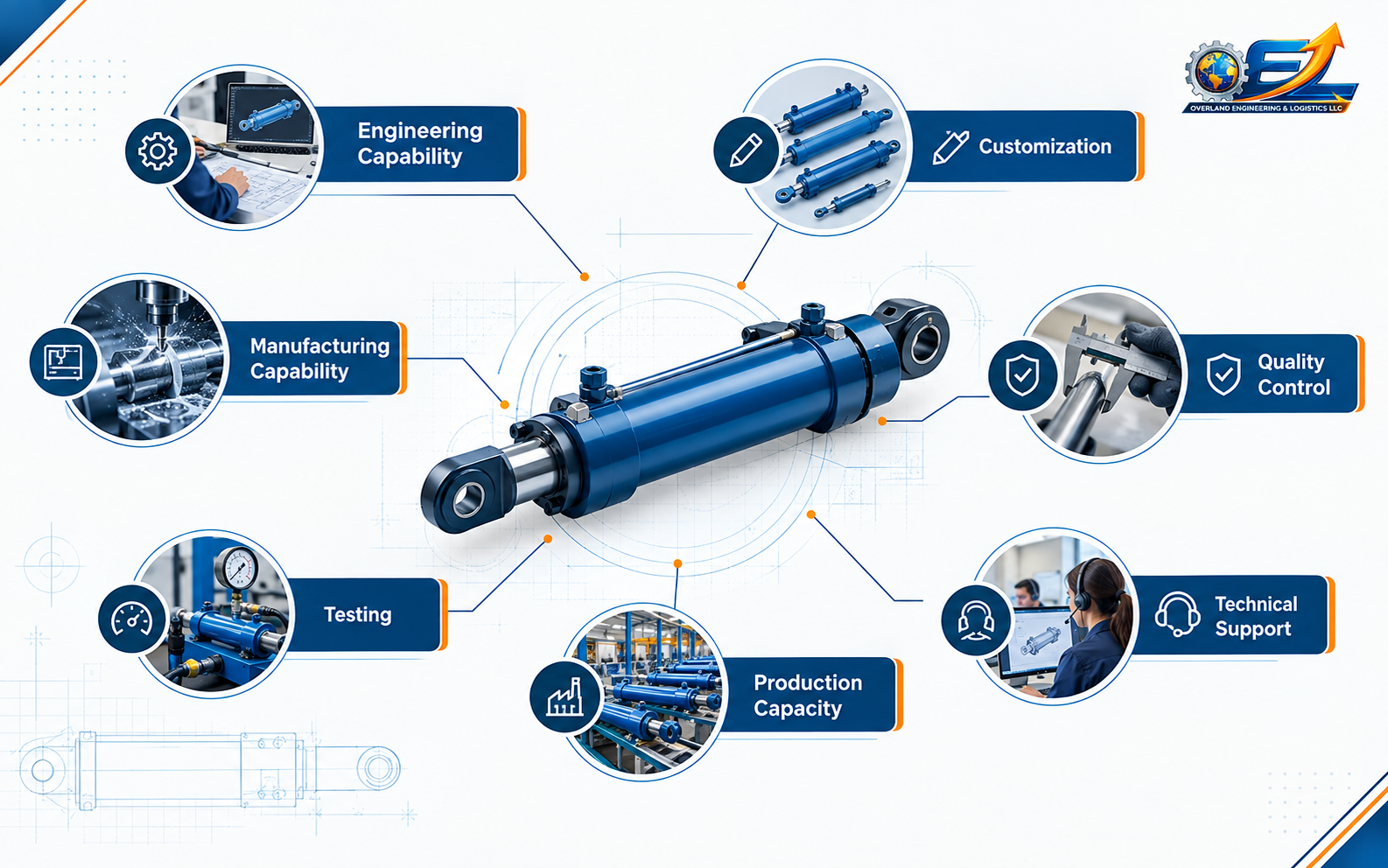
Before selecting a supplier, evaluate more than product availability and price. Consider engineering capabilities, manufacturing processes, customization options, quality control, testing, production capacity, and technical support.
Supplier Factor | Why It Matters |
Engineering capability | Helps develop a cylinder around the application |
Customization | Allows bore, stroke, seals, mounting, and other features to be specified |
Manufacturing capability | Supports consistent production and dimensional control |
Quality control | Helps identify dimensional and manufacturing issues |
Testing | Helps verify the finished cylinder against requirements |
Production capacity | Supports prototypes through serial production |
Lead time | Helps keep equipment and production schedules on track |
Technical support | Makes specification and application development easier |
OELUS combines custom engineering and manufacturing under one roof, with CNC capabilities and a process that takes custom cylinders from engineering review through first article and production.
Hydraulic Cylinder Manufacturer vs. Distributor
When sourcing hydraulic cylinders, buyers may work directly with a manufacturer or purchase through a distributor. The right option depends on the application and level of customization required.
Factor | Hydraulic Cylinder Manufacturer | Hydraulic Cylinder Distributor |
Product selection | Standard and custom options may be available | Typically focused on available products |
Custom design | Direct engineering support may be available | May depend on the manufacturer |
Engineering communication | Direct with the manufacturing team | Often through an intermediary |
Production changes | Can be discussed directly | Depends on manufacturing partner |
OEM applications | Well suited to custom production programs | Often focused on product supply |
Prototypes | May support one-off and pilot builds | Availability varies |
Custom specifications | Can be developed directly with production | May require additional coordination |
A hydraulic cylinder distributor can be useful when a standard replacement is readily available. For specialized OEM equipment or applications with unique requirements, direct access to engineering and manufacturing can simplify the development process.
7 Factors to Consider Before Choosing a Hydraulic Cylinder Supplier
1. Manufacturing and Engineering Capabilities
First, determine whether the supplier has the manufacturing and engineering capabilities required for your application.
Custom hydraulic cylinders may require specific bore sizes, stroke lengths, mounting configurations, seal packages, rod materials, coatings, ports, or integrated control components.
OELUS combines custom engineering with manufacturing capabilities, including precision CNC machining for components used in hydraulic-cylinder production. If you want to understand how CNC machining supports the production of precision components, see OELUS's guide to CNC Machining: Definition, Processes, Components & More.
2. Customization Options
A standard cylinder may not always fit the available installation space or performance requirements.
Depending on the application, you may need to customize:
- Bore diameter
- Stroke length
- Rod diameter
- Mounting configuration
- Cylinder tube
- Piston rod
- Seal package
- Ports
- Materials
- Surface treatments
- Cushioning
- Position sensing
A capable custom hydraulic cylinder manufacturer should be able to evaluate these requirements together rather than treating each specification separately.
OELUS engineers hydraulic, pneumatic, mill, welded, and tie-rod cylinder configurations, with custom modifications across structural, sealing, bearing, fluid-dynamics, and control requirements.
3. Quality Control and Testing
Hydraulic cylinders can operate under demanding pressure, temperature, load, and environmental conditions. Consistent manufacturing and inspection are therefore important.
When evaluating a supplier, ask about:
- Dimensional inspection
- Material traceability
- Seal inspection
- Surface finish
- Assembly controls
- Pressure requirements
- First-article inspection
- Quality documentation
A strong quality-control process helps ensure that cylinders meet the required specifications before they reach the final application.
4. Application Experience
A cylinder used in a steel mill may have very different requirements from one used in mobile equipment, mining, marine equipment, or an industrial press.
Consider the application's:
- Working pressure
- Load requirements
- Duty cycle
- Operating temperature
- Hydraulic fluid
- Side loading
- Vibration
- Dust and contamination
- Corrosion exposure
- Available installation space
Understanding these conditions helps a manufacturer select appropriate materials, seals, rod finishes, and cylinder configurations.
5. Lead Time and Production Capacity
A supplier should provide realistic expectations for quotation, prototype, and production stages.
OELUS states that custom quotes typically take 5–10 business days, while first-article production typically takes 3–6 weeks after quote approval, depending on complexity and tooling requirements.
Ask your supplier for separate timelines for:
- Engineering review
- Quotation
- First article or prototype
- Production
- Repeat orders
This makes it easier to coordinate purchasing and equipment production schedules.
6. Prototype and Production Support
OEMs and equipment manufacturers may need only one cylinder during the development stage before moving into pilot or serial production.
A supplier that supports prototypes, one-off builds, pilot batches, and serial production can help simplify this transition.
OELUS states that it has no minimum order quantity for custom cylinders and supports prototypes, one-off builds, pilot programs, and serial production.
7. Communication and Technical Support
Good communication can prevent specification errors and unnecessary delays.
When requesting a quotation, provide as much information as possible. Useful materials can include:
- CAD drawings
- 2D or 3D models
- OEM part numbers
- Existing cylinder information
- Application specifications
- Required quantity
- Operating environment
- Hydraulic fluid
- Temperature and duty-cycle information
OELUS accepts CAD files, drawings, failed samples, or sketches for its custom-cylinder engineering process.
When Should You Choose Custom Hydraulic Cylinders?
Custom hydraulic cylinders can be useful when a standard cylinder cannot meet the required combination of dimensions, performance, mounting, or environmental requirements.
Common situations include:
- The required stroke is not available in a standard cylinder.
- Mounting points do not match catalog dimensions.
- Installation space requires a specific cylinder size.
- A special bore or rod diameter is required.
- The cylinder must operate in extreme temperatures.
- A specialized seal package is needed.
- The application uses a specialized hydraulic fluid.
- An OEM requires a cylinder designed around new equipment.
- An existing cylinder requires an exact replacement or modification.
For these applications, a custom design can help ensure that the cylinder fits the equipment and meets the required operating conditions.
How to Compare Hydraulic Cylinder Suppliers
Instead of comparing suppliers only by unit price, use a broader sourcing checklist.
Evaluation Area | Questions to Ask |
Price | Is the quotation complete, including tooling where applicable? |
Engineering | Can the supplier review the application and drawings? |
Customization | Can the cylinder be built to your specifications? |
Quality | What inspections and quality systems are used? |
Testing | What first-article or production testing is available? |
Lead time | What are the quotation, prototype, and production timelines? |
MOQ | Can the supplier support prototypes and smaller batches? |
Capacity | Can it support future production requirements? |
Documentation | What inspection and quality documents are provided? |
Repeat orders | Can approved designs be reproduced consistently? |
This approach gives engineering and purchasing teams a clearer picture of the complete supplier relationship. For OEMs evaluating suppliers beyond individual cylinder specifications, OELUS also covers the broader sourcing process in How to Choose the Right Industrial Manufacturing Partner for OEMs, including quality systems, manufacturing capabilities, capacity, supply-chain considerations, and total cost.
Why Work With a Custom Hydraulic Cylinder Manufacturer?
For specialized equipment, the hydraulic cylinder is part of the machine's overall design. A supplier with integrated engineering and manufacturing capabilities can help connect application requirements with the final cylinder design.
OELUS provides custom hydraulic cylinders for OEM and industrial applications, with custom options covering cylinder geometry, seals, bearings, mounting, fluid control, and other application-specific requirements.
Its manufacturing capabilities also include CNC machining, casting, assembly, and other precision manufacturing processes, allowing customers to source multiple components through the same manufacturing partner.
Frequently Asked Questions
What should I look for in a hydraulic cylinder supplier?
Look for engineering expertise, customization options, manufacturing capabilities, quality control, testing, reliable lead times, and technical support.
What is the difference between a hydraulic cylinder manufacturer and a distributor?
A hydraulic cylinder manufacturer produces cylinders and can often provide direct engineering and customization support, while a distributor primarily supplies products from manufacturers.
When should I choose custom hydraulic cylinders?
Choose custom hydraulic cylinders when standard cylinders cannot meet your required bore, stroke, mounting, sealing, pressure, or environmental requirements.
What information is needed to order a custom hydraulic cylinder?
Provide the bore, stroke, rod diameter, operating pressure, mounting configuration, ports, seals, quantity, and available drawings or samples.
Does OELUS support hydraulic cylinder prototypes?
Yes, OELUS supports prototypes, one-off builds, pilot batches, and serial production with no minimum order quantity.
How long does a custom hydraulic cylinder quote take?
OELUS states that custom quotes typically take 5–10 business days, depending on project complexity.
Can OELUS manufacture cylinders from an existing sample?
Yes, OELUS can work from CAD files, drawings, failed samples, sketches, or existing cylinder information.
Ready to Source a Custom Hydraulic Cylinder?
Finding the right hydraulic cylinder supplier starts with understanding your application and defining the required specifications.
Whether you need a prototype, OEM replacement, pilot batch, or serial-production cylinder, choosing a supplier with engineering, manufacturing, inspection, and production capabilities can help simplify the sourcing process.
OELUS can review your CAD file, drawing, existing cylinder, failed sample, or application requirements and develop a custom solution around your equipment.
Request a Custom Hydraulic Cylinder Quote
Have a specific cylinder requirement? Send your application details to the OELUS engineering team.
Provide your drawing, CAD file, existing cylinder information, or sample along with the required quantity and application details.