Choosing the right metal casting process can affect production cost, part quality, tooling investment, lead time, and long-term performance. Two widely used options are die casting and sand casting.
Both processes can produce reliable industrial components, but they serve different manufacturing requirements. Die casting is commonly used for high-volume production of non-ferrous components, while sand casting provides greater flexibility for large parts, different materials, and lower production volumes.
So, which process is right for your part? The answer depends on your material, part size, design, production volume, tolerances, surface finish, and application.
Die Casting vs. Sand Casting: What's the Difference?
The main difference is the type of mold used.
Die casting forces molten metal into a reusable metal mold under high pressure. The reusable die allows manufacturers to produce consistent parts at high production rates.
Sand casting uses a sand mold created around a pattern. The mold is broken after the part solidifies, making it suitable for projects where flexible tooling, larger components, or lower production volumes are important.
For a broader range of casting options, explore OELUS Casting Services.
What Is Die Casting?
Die casting is a manufacturing process in which molten metal is injected into a reusable steel die under pressure. After the metal cools and solidifies, the part is removed and the die is ready for another production cycle.
Common die casting materials include:
- Aluminum
- Zinc
- Magnesium
Die casting is well suited to parts requiring repeatability, complex geometry, thin walls, and efficient high-volume production.
Benefits of Die Casting
- High production speed
- Excellent part-to-part consistency
- Complex shapes and detailed features
- Good dimensional accuracy
- Reduced machining requirements
- Suitable for high-volume production
The main consideration is the initial tooling investment. Because custom dies can be expensive, die casting generally becomes more attractive as production volume increases.
What Is Sand Casting?
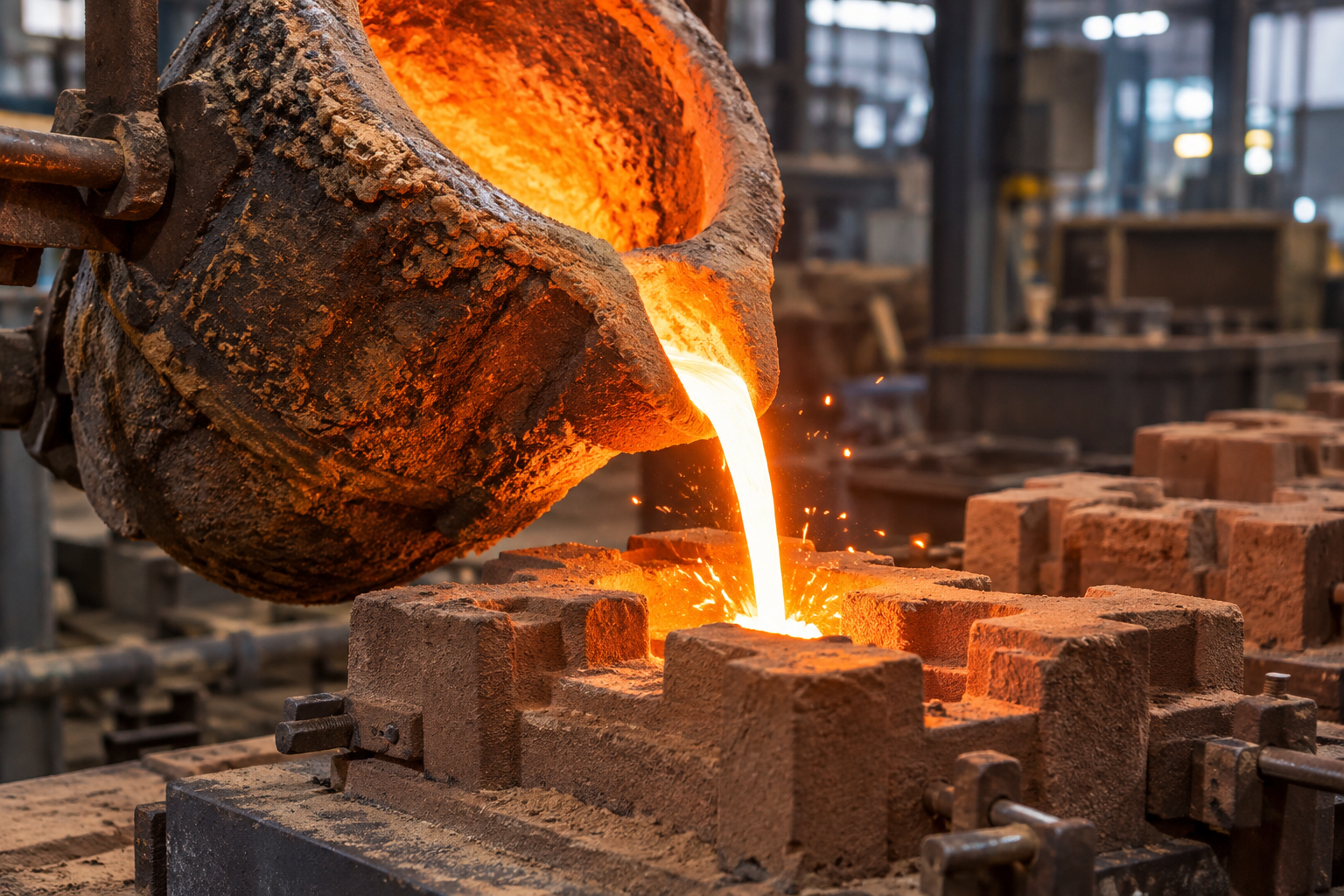
Sand casting creates a mold using specially prepared sand. Molten metal is poured into the mold cavity and allowed to solidify before the sand mold is removed.
One of the biggest advantages of sand casting is its material and size flexibility. Depending on the application, sand casting can be used with materials such as gray iron, ductile iron, carbon steel, stainless steel, aluminum, and copper-based alloys.
Benefits of Sand Casting
- Lower tooling investment
- Suitable for large and heavy components
- Broad material selection
- Suitable for low- to medium-volume production
- Flexible for complex geometries
- Useful for prototypes and custom components
Die Casting vs. Sand Casting: Key Differences
Factor | Die Casting | Sand Casting |
Mold | Reusable metal die | Sand mold |
Tooling cost | Higher | Lower |
Production volume | Medium to high | Low to medium |
Part size | Generally small to medium | Small to very large |
Materials | Mainly non-ferrous | Ferrous and non-ferrous |
Production speed | High | Lower |
Surface finish | Generally smoother | Generally rougher |
Dimensional consistency | Higher | Lower |
Thin-wall capability | Excellent | More limited |
These are general guidelines. The appropriate process should always be evaluated against the specific part design and production requirements.
Which Casting Process Is Right for Your Part?
Choose Die Casting When:
High production volume is required and tooling costs can be distributed across a large number of parts.
Consistent dimensions are important for repeat production.
Complex or thin-wall designs are part of the component requirements.
Non-ferrous materials such as aluminum, zinc, or magnesium are suitable for the application.
Choose Sand Casting When:
Large or heavy components are required.
Production volume is low or moderate and expensive permanent tooling may not be justified.
Ferrous materials such as iron or steel are required.
Design flexibility and lower initial tooling costs are important.
Die Casting vs. Sand Casting vs. CNC Machining
Casting is not always an alternative to machining. In many manufacturing projects, the two processes work together.
A cast component can be produced close to its final shape and then machined to achieve precise features such as:
- Bores
- Threads
- Sealing surfaces
- Bearing seats
- Mounting faces
OELUS can support these requirements through CNC Machining Services, helping manufacturers combine casting and precision machining within the same production strategy.
You can also learn more about the process in What Is CNC Machining? Definition, Processes, Components & More.
What Factors Should You Consider Before Choosing?
Before selecting die casting or sand casting, consider:
1. Production Volume
Determine how many components you expect to produce annually. Higher volumes may justify die casting tooling, while smaller runs may favor sand casting.
2. Material
The required alloy can significantly influence your process options. Determine whether your application requires aluminum, zinc, magnesium, iron, steel, or another material.
3. Part Size and Geometry
Large or heavy components may be better suited to sand casting, while detailed and repeatable smaller components may benefit from die casting.
4. Tolerances
Identify which dimensions can remain as-cast and which features require secondary machining.
5. Surface Finish
Consider whether the part requires additional processes such as machining, grinding, blasting, coating, plating, or painting.
6. Total Manufacturing Cost
Look beyond the initial tooling price. Compare tooling, per-part production, machining, finishing, inspection, and logistics costs across the expected production volume.
Casting for Hydraulic and Industrial Components
Casting is widely used for industrial components such as housings, brackets, valve bodies, pump components, and other equipment parts.
For fluid-power applications, cast components can also be combined with OELUS Hydraulic Cylinders and other hydraulic solutions.
If your project involves hydraulic equipment, you can also read How to Choose the Right Hydraulic Cylinder for Your Application for additional guidance.
Why Choose an Experienced Manufacturing Partner?
Selecting the right process is only one part of a successful manufacturing project. Your supplier should also have the equipment, engineering knowledge, quality systems, inspection capabilities, and production capacity needed for your application.
For OEM projects involving multiple manufacturing processes, see How to Choose the Right Industrial Manufacturing Partner for OEMs.
OELUS provides multiple manufacturing capabilities, including die casting, sand casting, investment casting, CNC machining, hydraulic cylinders, plastic injection molding, and metal stamping.
Conclusion
The choice between die casting and sand casting ultimately depends on the requirements of your part and production program.
Die casting can be a strong fit for high-volume, repeatable non-ferrous components requiring complex geometry and efficient production.
Sand casting can be a practical choice for large or heavy components, lower production volumes, broader material requirements, and projects where lower tooling investment is important.
When the right process is combined with appropriate design, machining, finishing, and quality control, casting can provide an efficient foundation for producing reliable industrial components.
If you are evaluating a new casting project, explore OELUS Casting Services to review available manufacturing capabilities and discuss your part requirements.
Frequently Asked Questions
Is die casting better than sand casting?
Die casting suits high-volume, detailed parts, while sand casting offers greater flexibility for larger or lower-volume components.
Which is cheaper, die casting or sand casting?
Sand casting typically has lower tooling costs, while die casting can offer lower per-part costs at higher volumes.
Can aluminum be used for both die casting and sand casting?
Yes, aluminum can be used in both processes depending on the part design and production requirements.
Which casting process is best for large parts?
Sand casting is generally more suitable for large and heavy components.
Can cast parts be CNC machined?
Yes, cast parts can be CNC machined for precise bores, threads, mounting surfaces, and other critical features.
How do I choose between die casting and sand casting?
Consider your material, part size, production volume, geometry, tolerances, tooling budget, and application.
Does OELUS provide both casting and CNC machining?
Yes, OELUS provides casting and CNC machining capabilities for suitable manufacturing projects.
Can OELUS support OEM casting projects?
Yes, OELUS supports OEM manufacturing projects across casting, machining, and other manufacturing processes.