When selecting a hydraulic cylinder, one of the first questions to answer is whether you need a single-acting or double-acting hydraulic cylinder.
Both types convert hydraulic pressure into linear motion, but they operate differently. A single-acting cylinder uses hydraulic pressure to move in one direction and relies on an external force for the return stroke. A double-acting cylinder uses hydraulic pressure to control movement in both directions.
The right choice depends on how your equipment operates, the force required, the available installation space, and whether the cylinder needs controlled movement during both extension and retraction.
What Is a Single-Acting Hydraulic Cylinder?
A single-acting hydraulic cylinder uses hydraulic pressure to move the piston in one direction. Hydraulic fluid enters the cylinder and pushes the piston, causing the rod to extend.
When hydraulic pressure is released, the cylinder returns through an external force such as gravity, the weight of the load, a spring, or another mechanical mechanism.
In simple terms, a single-acting cylinder provides hydraulic power in one direction.
How Does a Single-Acting Cylinder Work?
The operating cycle is straightforward:
- Hydraulic fluid enters the cylinder.
- Pressure pushes the piston and extends the rod.
- Hydraulic pressure is released.
- Gravity, the load, a spring, or another external force retracts the cylinder.
This design can be a practical choice when powered retraction is not required.
Common Applications
Single-acting hydraulic cylinders are commonly used in:
- Dump trucks
- Dump trailers
- Tippers
- Agricultural equipment
- Lifting equipment
- Certain presses
- Material-handling applications
For example, a dump truck may use hydraulic pressure to raise the dump body. When the body needs to return to its original position, its weight can provide the force needed to retract the cylinder.
What Is a Double-Acting Hydraulic Cylinder?
A double-acting hydraulic cylinder uses hydraulic pressure to control movement in both directions.
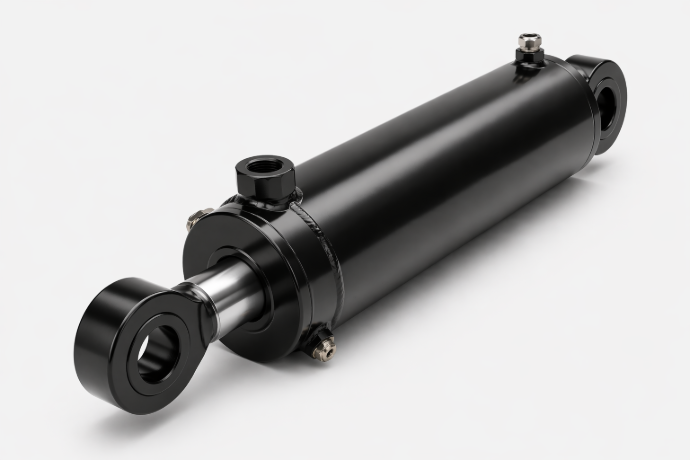
The cylinder has hydraulic connections that allow fluid to enter either side of the piston. One direction of hydraulic flow extends the cylinder, while the other retracts it.
Unlike a single-acting design, the cylinder does not need to rely on gravity or the load to provide the return force.
How Does a Double-Acting Cylinder Work?
A typical double-acting cylinder operates by:
- Sending hydraulic fluid to one side of the piston.
- Using pressure to extend the cylinder.
- Redirecting hydraulic fluid to the opposite side.
- Using pressure to retract the cylinder.
This provides active hydraulic control over both strokes.
Double-acting cylinders are useful when equipment requires controlled movement in both directions or when the cylinder must retract against resistance.
Single-Acting vs Double-Acting Hydraulic Cylinders
The main difference between these two hydraulic cylinder types is how the return stroke is powered.
Feature | Single-Acting | Double-Acting |
Hydraulic-powered movement | One direction | Both directions |
Retraction | Gravity, load, spring, or external force | Hydraulic pressure |
Hydraulic connections | Typically one working port | Typically two ports |
Retraction control | Limited | Controlled hydraulically |
System complexity | Generally simpler | Generally more complex |
Typical applications | Dumping and lifting | Controlled push/pull applications |
Neither type is automatically right for every machine. The correct configuration depends on the application and how the equipment needs the cylinder to move.
When Should You Use a Single-Acting Hydraulic Cylinder?
A single-acting cylinder may be suitable when:
- Hydraulic force is required in only one direction.
- Gravity can reliably return the cylinder.
- The load provides the return force.
- A spring or mechanical mechanism can retract the cylinder.
- Powered retraction is not necessary.
- A simpler hydraulic arrangement is preferred.
For example, single-acting cylinders are commonly used on dump trucks and tippers because the weight of the body can help retract the cylinder.
If the equipment requires a long stroke but has limited space for the cylinder when retracted, a telescopic hydraulic cylinder can provide a longer stroke in a compact package.
When Should You Use a Double-Acting Hydraulic Cylinder?
A double-acting cylinder may be appropriate when:
- The cylinder must actively retract.
- Gravity cannot reliably return the cylinder.
- The cylinder needs to retract against resistance.
- Movement must be controlled in both directions.
- The equipment performs repeated push-and-pull movements.
- Consistent positioning is important.
Typical applications include construction equipment, refuse equipment, cranes, aerial platforms, agricultural machinery, and industrial equipment.
The additional hydraulic control makes double-acting cylinders useful where simply allowing the load to return the cylinder is not enough.
Single-Acting vs Double-Acting Telescopic Hydraulic Cylinders
The same choice applies to telescopic hydraulic cylinders.
Telescopic cylinders use multiple nested stages to provide a long stroke while keeping the cylinder relatively short when retracted. This makes them useful for equipment where installation space is limited.
For example, dump trucks and trailers may require a long stroke to raise the body but have limited space beneath the chassis.
OELUS offers telescopic cylinders with two to five stages and strokes up to 240 inches, with both single-acting and double-acting configurations available.
Single-Acting Telescopic Cylinders
Single-acting telescopic cylinders can be suitable for dump trucks, dump trailers, tippers, and similar applications where gravity or the load can retract the cylinder.
Double-Acting Telescopic Cylinders
Double-acting telescopic cylinders are useful where powered and controlled retraction is required, including applications such as refuse packers, roll-off equipment, cranes, and aerial platforms.
Other Factors to Consider When Selecting a Hydraulic Cylinder
Choosing between single-acting and double-acting is only one part of hydraulic cylinder selection.
1.Stroke Length
The stroke determines how far the cylinder needs to extend. If a long stroke is required but there is not enough space for a conventional cylinder, a telescopic design may be a better option.
2.Bore Diameter
Bore size affects the force a cylinder can produce at a given hydraulic pressure. It should be selected according to the equipment's load, pressure, mechanical geometry, and operating requirements.
3.Operating Pressure
The cylinder must be designed for the hydraulic system's operating pressure and expected loads. OELUS's hydraulic-cylinder range includes bore sizes from 1.5 to 12 inches and working pressures up to 5,000 psi, depending on the cylinder type and application.
4.Mounting
Mounting dimensions must match the equipment. Pin diameter, mounting width, extended and retracted length, port location, and mounting style should all be checked before selecting a replacement cylinder.
5.Duty Cycle and Environment
Consider how often the cylinder operates and the conditions it will experience. Temperature, hydraulic fluid, contamination, load, operating frequency, and expected service life can all influence cylinder design.
6.Seal and Material Requirements
Seal materials, rod finishes, bearings, and other components should be selected according to the application. OELUS offers custom hydraulic-cylinder configurations with different sealing, mounting, and design options.
Standard or Custom Hydraulic Cylinder?
A standard cylinder may be suitable when the required bore, stroke, mounting, pressure, and other specifications match an existing design.
A custom hydraulic cylinder may be necessary when the application requires non-standard dimensions, mounting arrangements, seal packages, materials, ports, or operating conditions.
OELUS engineers both single-acting and double-acting custom hydraulic cylinders for OEM and industrial applications.
When replacing an existing cylinder, start with the original manufacturer's part number and specifications. Measurements such as bore, stroke, retracted length, extended length, mounting dimensions, and port configuration can help identify the correct replacement.
How Do You Choose the Right Type?
A simple way to approach hydraulic cylinder selection is to ask:
1.Does the cylinder need hydraulic power to retract?
If not, a single-acting cylinder may be suitable.
2.Does the cylinder need controlled movement in both directions?
If yes, a double-acting cylinder may be required.
3.Can gravity or the load reliably return the cylinder?
If yes, a single-acting design may work.
4.Is the required stroke longer than the available installation space?
If yes, consider a telescopic hydraulic cylinder.
5.Are the required dimensions or specifications unusual?
A custom hydraulic cylinder may be the appropriate solution.
Concluding
The choice between single-acting vs double-acting hydraulic cylinders depends on how the equipment needs the cylinder to operate.
A single-acting cylinder uses hydraulic pressure in one direction and relies on an external force for retraction. A double-acting cylinder uses hydraulic pressure for both extension and retraction, providing greater control over the complete stroke.
For dump trucks, tippers, and similar equipment where gravity or the load can return the cylinder, a single-acting configuration may be suitable. For machinery that requires controlled movement in both directions, a double-acting cylinder may be more appropriate.
However, acting is only one part of the decision. Stroke, bore, pressure, mounting, duty cycle, environment, and available space should also be considered.
If you are replacing an existing cylinder or developing a new OEM application, OELUS can work from your specifications, drawing, OEM part number, sample, or application requirements to help identify or engineer the appropriate hydraulic-cylinder solution.
Frequently Asked Questions
1. What is the difference between a single-acting and double-acting hydraulic cylinder?
A single-acting cylinder uses hydraulic pressure in one direction, while a double-acting cylinder uses hydraulic pressure for both extension and retraction.
2. When should I use a single-acting hydraulic cylinder?
Use a single-acting cylinder when gravity, the load, or another external force can reliably return the cylinder.
3. When should I use a double-acting hydraulic cylinder?
Use a double-acting cylinder when hydraulic power and controlled movement are required during both extension and retraction.
4. Can telescopic hydraulic cylinders be single-acting or double-acting?
Yes, telescopic hydraulic cylinders are available in both configurations depending on the equipment and movement requirements.
5. How do I choose the right hydraulic cylinder?
Consider the required force, stroke, bore, pressure, mounting, duty cycle, acting type, available space, and operating environment.